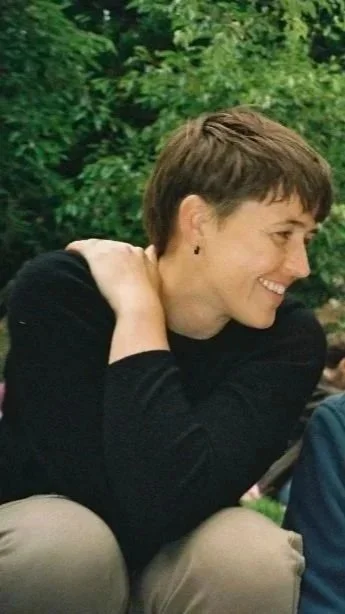
Dylan Cowie-Haskell
We store memories of fear and pain in our body. Most of these memories live beneath our awareness because our minds are working hard not to be in touch with these experiences. Understandably so, as most of our pain is experienced at a phase in our development when we are living in emotions, before our neocortex is fully developed, and so emotions are felt to a terrifying degree if we do not have loving adult accompaniment (most of us did not). We do whatever we can do in these overwhelming moments to diminish emotional experience- disconnect, numb, contract, dissociate, resist. We learn that these efforts work and we keep doing them.
Our bodies do the honorable work of holding all that unfinished emotional experience through patterns of contraction and numbness so that we do not have to consciously face it again. Next time you cry pay attention to how rigid your face muscles go and how much pressure is in your chest- this will give you a sense of the work your body is doing to keep pain at bay. These patterns of contraction are intelligent survival strategies at the time but what happens is they turn automatic. As we leave the emotionally unsafe environments of our childhoods we find ourselves needing to emote but unable to. Emoting is a biologically necessary experience. Crying, laughing, shaking with fear and anger, all of these expressions of emotion keep us well and provide direction. If we restrict these expressions, imbalances happen on a physical level and we experience chronic discomfort and pain. We try to figure things out about our bodies from ideas handed to us by the same culture that promotes disembodiment. A good example of this is how widespread gastrointestinal issues are and how many theories and products exist to “fix” them. Could it be as simple as a lifetime of contracting around fear in the belly?
One problem with all of this emotional experience stored underneath awareness is that we can easily be triggered without understanding what is happening leading to more fear and reactivity. I have worked with many people who experience recurring panic attacks or anger outbursts which are then intensified by the mind’s fixation on feeling out of control. We assume something is wrong with us when these moments happen, leading to further contraction and disconnection out of the primal fear of being broken. The underlying fear of our internal world grows the more we disconnect from it.
There is nothing wrong with us. We just have a lot of unfinished emotional business. The work is not simply “release” or “nervous system regulation”— these phrases that are used so commonly. Rather, it’s mindbody integration. What this means is becoming fully aware of yourself— your patterns of reactivity and where they come from and engaging in a process of completing unfinished business through the mindbody (mourning unmet emotional needs and completing frozen experiences) and then choosing a new story, preferably one where you are no longer a victim but empowered to take care of your emotional and physical needs moment to moment. This is not theoretical; this means breathing long and slow, relaxing unnecessary tension, agreeing to allow and be guided by emotional experience— essentially paying attention to and heeding the feedback in your body on an experiential level.
There are many amazing bodywork methods where you can experience deep release and embodied understanding. There are many amazing psychotherapeutic modalities where you can gain helpful insight. The trouble is the experiences of insight and embodiment don’t get integrated into a conscious understanding of who you are, including your “demons” and “shadows”. Or, as I like to put it the mind-body patterns that kept you safe. Consider that the way you judge others and group them into hierarchies of better and worse is simply a learned pattern of control that made you feel safer in a world where adults were doing that to you. It’s not pretty but you do it. This is only part of a semi-conscious pattern that involves all of you. We make these patterns conscious so you can observe them and then decide if you want to keep maintaining them. My work is all about self-trust because to trust yourself you need to know yourself. To know yourself you need to go towards and through what scares you. Many of us live scared of ourselves and of others. Many of us understandably do not dare go towards that unknown because there is a primal fear of being exposed as broken and unworthy. We often can’t do it alone. I accompany people towards the unknown and help them help themselves cross the bridge from fragmentation to integration. This experience is the basis of self-trust.
My Approach
I have spent my life deeply dedicated to the process of becoming who I am. I have gone down many roads in this process and have taken something with me from most of them. Although I am formally educated with a BA in Anthropology and Psychology and a Masters in Social Work, I attribute my wisdom more to my informal, life education. After 30 years of researching, traveling, working with so many different humans, and continuously being in my own daily practice of honest listening, I live solidly in my commitment to people’s freedom. Part of what makes my work so powerful is that unlike so many others I do not pretend to know what is best for you. I ask the question and I listen. Life has taught me that we are the only people who can truly empower ourselves. I have brought myself out of many dark places, yes with the wisdom and support of others, but mostly with my own body intelligence guiding me into the knowledge that I do not have to spend this life suffering unnecessarily. Life is and always will be full of pain but I learned to choose to see the pain through the lens of beauty. I know we all have this inherent intelligence and my work is to shed this light.
I live queerly, meaning I cherish and foment moments of norm disruption and play. I spend a lot of my free time dancing Contact Improvisation and enjoy teaching this form as well. I go for walks and sometimes I bask in the wonder, other times I bask in my inner monologue. I engage in deep relational practice with my loved ones, always questioning and working for more joy and freedom.
You can read more on my Substack if you’d like.
About Me
References
I encourage you to explore this material yourself
Books
The Feeling of What Happens- Antonio Damassio
How Emotions are Made - Dr. Lisa Feldman Barret
The Developing Brain- Dr. Dan Siegel
The Boy Who Was Raised By a Dog- Dr. Bruce Perry
The Language of Emotions- Karla McLaren
Joy: Surrender to Life and the Body- Alexander Lowen
How To Be An Adult - David Richo
Becoming Yourself: Body Attention and The Fulfillment of Potential - Avi Grinberg
What it Takes to Heal- Prentiss Hemphill
Thinking in Systems- Donatella Meadows
Sensing, Feeling and Action- Bonnie Bainbridge Cohen
Anatomy Trains: Myofascial Meridians for Manual and Movement Therapists - Thomas W. Meyers
Healing Back Pain and The Mind-Body Prescription By Dr. John Sarno
The Myth of Normal and Scattered Minds - Gabor Mate
The Body Keeps the Score- Bessel Van Der Kolk
The Heart Atlas- Brene Brown
Attachment Theory in Practice and Hold Me Tight- Dr. Sue Johnson
Focusing - Eugene Gendlin
Youtube